About Puja (Vivah Sanskar – Hindu Marriage Ceremony)
Vivah Sanskar is one of the most important Hindu sacraments, performed after the Samavartan Sanskar, and it grants entry into the Grihastha Ashram (householder stage of life) among all four ashrams of Hindu Dharma. Only after performing Vivah Sanskar does a person become eligible to follow the duties of household life. According to Acharya Manu, one must strictly follow the principles of Grihastha Dharma after marriage.
The Grihastha Ashram is considered the foundation and sustainer of all other ashrams, and without it, balance and peace in life cannot be established. As per Daksha Smriti, the Grihastha Ashram is the source of all other ashrams. Just as all living beings grow under maternal protection, all religious and cultural values are nurtured through household life.
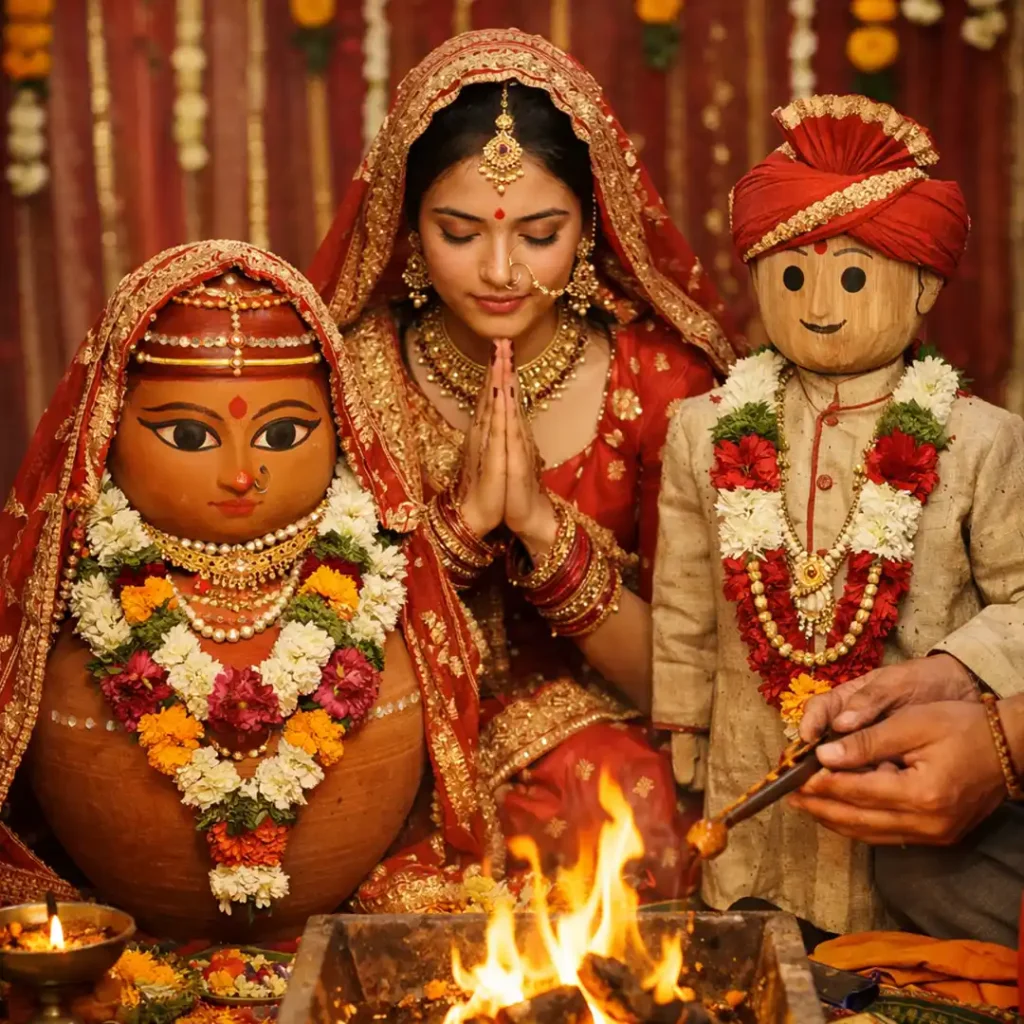
The foundation of the Grihastha Ashram is the woman, through whom a house truly becomes a home and social stability is established. Vivah Sanskar creates a sacred bond between the bride and groom, solemnized in the presence of Agni (sacred fire) and the divine deities. Outwardly it appears to be a celebration, but spiritually it symbolizes Vedic discipline and sacred responsibility.
The true purpose of marriage is not merely physical union, but the fulfillment of social and spiritual duties, righteous living, continuation of lineage, cultivation of virtues, service to all beings, and inner fulfillment. Through marriage, the establishment of the four Purusharthas—Dharma (righteousness), Artha (prosperity), Kama (balanced desires), and Moksha (liberation)—takes place.
Vivah Sanskar recognizes husband and wife as complementary partners and inspires them to live a disciplined and value-based life. Through Vedic mantra chanting, mental, intellectual, and spiritual growth is awakened, strengthening the foundation of mutual love and trust. The Indian marriage system recognizes marriage as a bond for seven lifetimes, creating an unbreakable lifelong relationship.
Marriage binds the husband to Ekpatnivrata Dharma (commitment to one wife) and the wife to Pativrata Dharma (devotion to her husband), strengthening love and trust throughout life. After marriage, the couple jointly performs religious duties and yajnas, guiding their household life toward spiritual completeness.
Benefits (Significance of Vivah Sanskar)
Vivah Sanskar holds immense importance in Sanatan culture, where blessings of deities and ancestors are invoked. During the wedding ceremony, the Matrikas (Divine Mothers) are welcomed, whose grace ensures a prosperous and harmonious life for the couple. In marriage rituals, the groom is worshipped as Lord Vishnu, and the bride as Goddess Lakshmi, and hence their worship is performed in the form of Lakshmi–Narayan Puja.
One of the most sacred aspects of marriage is Kanyadaan, which is regarded as the greatest form of donation. In this ritual, the bride’s father is considered the embodiment of Lord Varuna, and through Kanyadaan, he attains immense spiritual merit.
After Kanyadaan, the bride and groom circumambulate Agni Dev, accept each other as life partners, and perform sacred homa rituals, offering oblations with Vedic mantras for happiness, prosperity, and righteous living.
Holding each other’s thumb symbolizes lifelong cooperation and trust. During Laja Homa, the bride prays for her husband’s long life and prosperity of his lineage. In Ashmarohan, the groom prays for the unshakable fortune of his wife. The circumambulation of the sacred fire strengthens mutual blessings and unity.
Through Saptapadi, the couple takes a solemn vow of lifelong friendship, love, and support. The sight of Dhruva and Arundhati reinforces the permanence and stability of this sacred bond. Since the entire Vivah Sanskar is performed with Vedic mantras, it ensures a righteous, prosperous, and spiritually elevated married life.
The sacred mantras unify the hearts, thoughts, and minds of the couple. Panigrahan Sanskar symbolizes an unbreakable bond for life. During Kanyadaan, the father offers his daughter, considered Goddess Lakshmi, to the groom, considered Lord Vishnu, so that their married life remains gentle, prosperous, and harmonious.
Thus, SHRADDHA’s Vivah Sanskar not only ensures lifelong marital happiness and dharmic living but also strengthens love, stability, and fulfillment of social responsibilities.
Process (Vivah Sanskar Ritual Procedure)
- Ganesh Puja – Invocation of Lord Ganesha for removal of obstacles
- Swastivachan & Sankalp – Sacred vow for successful completion of the ceremony
- Kanyadaan – Bride is offered by her father to the groom
- Mangal Pheras & Saptapadi – Sacred circumambulation and seven vows around Agni
- Sindoor Daan & Mangalsutra – Symbol of marital commitment
- Ashirvad – Blessings from elders and priests
Puja Samagri
Puja Items Provided by SHRADDHA
- Sacred Thread (Kalava), Vermilion Powder (Roli)
- Sindoor, Betel Nuts
- Cloves, Cardamom
- Turmeric Powder, Abir
- Mica Powder (Abhrak), Gulal
- Rose Water, Holy Ganga Water
- Honey, Perfume (Itr)
- Cotton Wicks, Raw Cotton
- Incense Sticks, Yellow Mustard Seeds
- Sacred Thread (Yagyopavit), Camphor
- Desi Ghee, Matchbox
- Large Dona Bowls, Panchmeva (Five Dry Fruits)
- White Sandalwood, Red Sandalwood
- Rice (Small Grain), Earthen Lamp
- Sacred Soil (Saptamrittika)
- Seven Sacred Grains (Saptadhanya), Sacred Herbs (Sarva Aushadhi)
- Panchratna (Five Gemstones), Rock Sugar (Mishri)
- Yellow Cotton Cloth
- Ashtagandha Sandalwood
Havan Material & Ritual Utensils
- Black Sesame Seeds, Rice
- Lotus Seeds (Kamal Gatta)
- Havan Samagri, Guggul
- Desi Ghee, Jaggery (or Sugar)
- Papad (Symbolic Offering)
- Black Urad Dal
- Purna Patra (Offering Bowl)
- Prokshani, Pranita, Sruva, Suchi, Sphya – Complete Set
- Copper Havan Kund (10×10 or 12×12 inches)
- Powdered Sandalwood
- Navgraha Samidha
- Havan Samidha, Ghee Vessel
- Kusha Grass
- Panch Patra
Arrangements to be Made by the Yajman
- Wooden Chowki (2×2 ft) – 1
- Cow’s Milk – 100 ml
- Curd – 50 ml
- Sweets (As Required)
- Assorted Fruits
- Durva Grass – 1 Handful
- Betel Leaves – 6
- Fresh Flowers – 2 kg
- Flower Garlands – 7
- Mango Leaves – 2
- Bilva Leaves – 21
- Tulsi Leaves – 7
- Shami Leaves & Flowers
- Water-filled Coconut
- Plates (2), Bowls (5), Lota (2), Spoons (2)
- Akhand Deepak – 1
- Copper or Brass Kalash with Lid
- Clothes for Deities (Dhoti, Gamcha, etc.)
- Mats, Sheets & Asan for Seating
Cow Milk & Curd





Reviews
There are no reviews yet.